Nvidia-SK Group's $500B AI Partnership Signals Massive Infrastructure Race as Costs Squeeze Hosting Margins
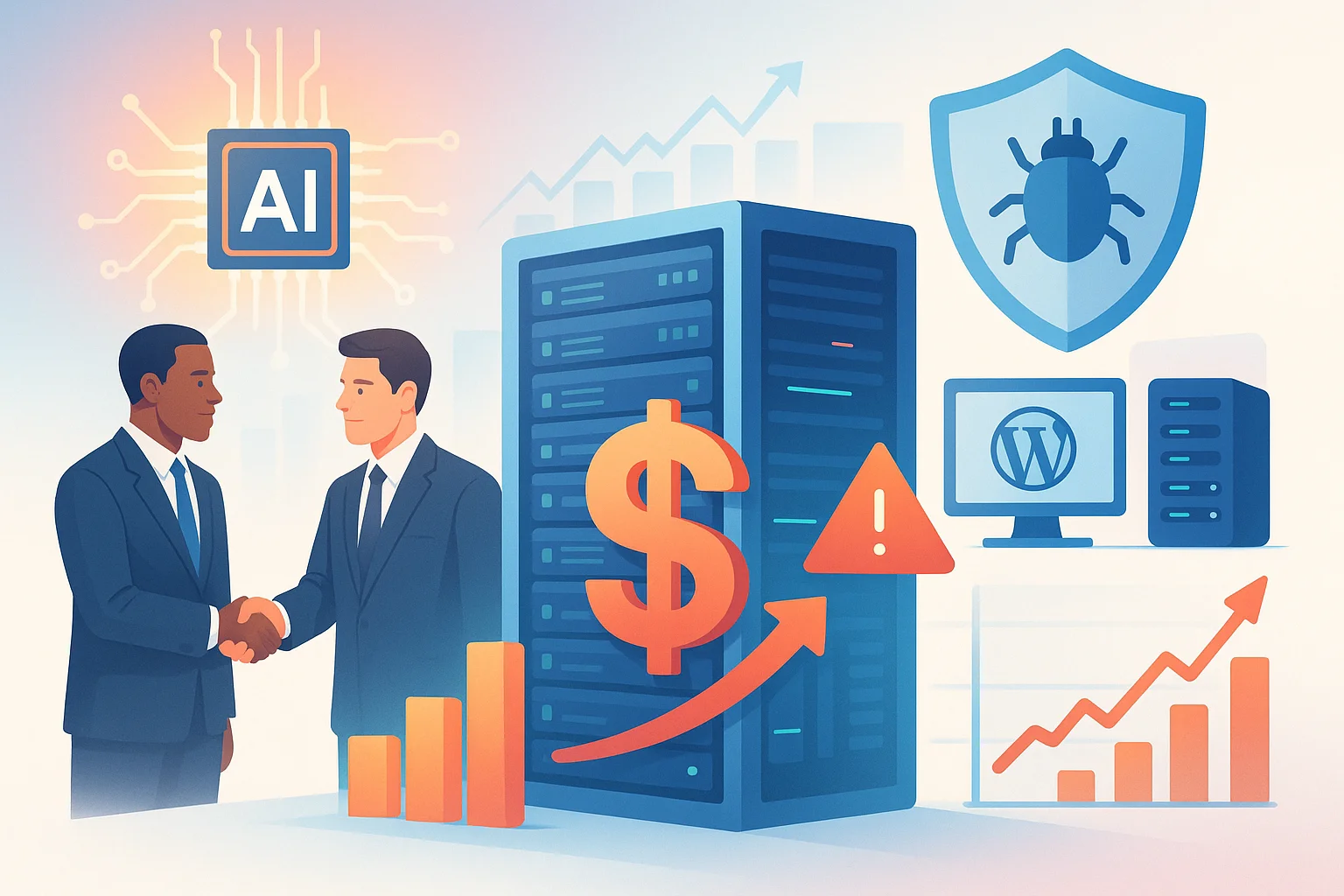
Key Themes
Notable Players
Announced $500B strategic partnership covering memory supply, 2 GW AI data center, and long-term AI infrastructure development.
Launched Helios rack-scale AI system with MI455X accelerators and secured major deployments at Microsoft Azure and Anthropic (2 GW commitment).
Suffered 5-hour Azure California outage due to fiber maintenance error affecting 27 services; committed to large-scale AMD Helios deployment.
Announced 2 GW supply commitment from AMD for MI450 GPUs; targeted by alleged Chinese IP theft claims.
Acquired ZebraHost for $1.1M, nearly doubling company size in mid-market hosting consolidation move.
Top Stories
Historic $500B strategic partnership covers long-term memory supply, 2 GW AI data center construction, and future AI infrastructure expansion. Signals unprecedented capital commitment in AI semiconductor competition.
Critical cPanel CVE-2026-41940 authentication bypass now exploited via GitHub Actions runners, providing attackers with free compute to target vulnerable servers. Patch urgency elevated as attack vector moved to third-party infrastructure.
AMD commits $5B investment and 2 GW of MI450 GPUs to Anthropic, with first gigawatt coming online H1 2027 in Helios rack systems. Major blow to Nvidia's dominance as AMD secures long-term AI inference deals.
First half of 2026 marked a climate shift for hosting economics, with energy, hardware, licensing, and software costs spiking across every layer. Providers face structural margin compression requiring strategic repricing.
Veteran-owned hosting provider acquires cloud and colocation competitor for $1.1M, demonstrating continued consolidation in mid-market hosting sector. Deal reflects M&A activity beyond mega-cap players.
Security & Compliance
Emergency WordPress patch on July 17 closed critical unauthenticated RCE vulnerabilities in core code now under active exploitation. Rare core-level flaw impacts massive share of web requiring immediate updates.
WordPress core vulnerability represents rare security event with deployment lag between patches and actual protection. Gap between patched code and safe deployments creates extended exploitation window.
Critical F5 patch for Nginx CVE-2026-41940 addresses vulnerability dormant since 2011, rated 9.2 severity. Long-standing web server flaw affects infrastructure across hosting ecosystem.
Newly disclosed KVM hypervisor escape vulnerability disclosed July 6 required OVHcloud to patch million-plus VMs over week-long campaign. Ancient virtualization flaw impacts massive provider infrastructure.
Cloud & Infrastructure
Maintenance mistake severed fiber connectivity, taking out 27 Azure services for nearly 5 hours. Highlights operational risks even at hyperscale infrastructure providers.
Microsoft and AMD partnership brings Helios systems and MI455X accelerators to Azure at scale, diversifying away from Nvidia dependency. Major strategic shift in cloud AI infrastructure.
Single datacenter power problem took down three services while rest of zone kept running, raising questions about resilience architecture transparency. Demonstrates complexity of hyperscale outage containment.
Pricing & Business
Analysis of whether hosting providers should increase customer prices amid energy, hardware, licensing, and software cost escalation. Examines margin compression and pricing strategy options.
Deep dive into structural cost drivers reshaping hosting economics: energy, hardware, software licensing, and margin-focused vendor strategies. Identifies root causes of unprecedented margin pressure.
Acquisitions & Market
Samsung and SK Hynix expected to unveil multibillion-dollar memory partnerships with major U.S. tech firms during South Korean President Lee's Silicon Valley visit. Signals major geopolitical AI infrastructure realignment.
Domains & DNS
Verisign announced victory on .web TLD pursued since 2012, with uncapped registry pricing unlike legacy .com. Long regulatory battle finally resolved with major implications for new TLD economics.
Technology & Tools
AMD's Helios rack-scale systems and MI455X accelerators challenge Nvidia dominance, targeting next-wave agentic AI adoption. Hardware innovations reshape competitive AI infrastructure landscape.
AMD showcased MI455X accelerator and Helios architecture at Advancing AI 2026, demonstrating competitive performance, large HBM memory, and rack-scale integration. Viable alternative to Nvidia's GPU monopoly.
AMD Helios integrates with Cerebras' wafer-scale solutions for ultimate low-latency AI inference performance. Strategic collaboration combines complementary architectures for data center optimization.
Data Centers & Infrastructure
Transmission line fault in Data Center Alley caused 3 GW sudden load drop when facilities shifted to backup power. Represents one of largest publicly reported sudden grid load changes in U.S.
Federal study concludes AI data centers now dominant driver of electricity demand growth, forcing grid planners to rethink expansion strategies. Fundamental shift in infrastructure planning priorities.
BNEF nearly doubled 2035 data center power forecast to 194 GW from 106 GW projection, reflecting explosive AI infrastructure growth. One-fifth of U.S. power consumption by decade's end.
Data center construction now most capacity-constrained sector globally due to AI infrastructure growth and labor shortages. Building supply cannot keep pace with demand from hyperscalers and AI companies.
Macquarie secures Sydney real estate for 200 MW data center campus expansion. Major APAC infrastructure commitment capitalizes on regional AI demand.
Planned 300 MW Spanish AI campus pursues fast-track approval with on-site power generation strategy to bypass grid constraints. European-scale AI infrastructure bet on energy independence.
New York executive order pauses permits for data centers above 50 MW while developing rules for grid costs, water use, and host communities. Regulatory pushback on rapid AI infrastructure expansion.
TSMC raises capital spending forecast after cloud providers signal robust demand for AI infrastructure. Semiconductor manufacturing expansion reflects sustained data center growth trajectory.
Other News
White House claims Chinese K3 AI model derived from Anthropic IP, with Thailand hosting suspected in distillation attack. Highlights geopolitical competition and IP theft risks in AI infrastructure.
Google internally hoarding TPUs for AGI research while purchasing third-party compute to handle G-Cloud demand. Reveals tension between internal research priorities and commercial cloud commitments.