Linux kernel vulnerabilities threaten shared hosting; SK Hynix raises record $26.5B for AI memory expansion
Key Themes
Notable Players
Raised record $26.5B in historic Nasdaq IPO to fund HBM manufacturing expansion amid AI demand surge; forecasts worst memory shortage in 2027 lasting until 2030.
Landed nine-figure AI infrastructure deals; backlog jumped tenfold in latest quarter, signaling shift from hourly billing to enterprise AI workloads.
Turned on Patchstack npm vulnerability scanning for Node.js apps by default, treating dependency security as standard feature rather than add-on.
Warned Indian court it may exit the country over domain-privacy ruling; released urgent guidance on GhostLock Linux kernel vulnerability (CVE-2026-43499) for self-managed VPS customers.
Launched Code, a white-label AI coding platform for web hosts, expanding the hosting industry's AI-powered site-building toolchain.
Top Stories
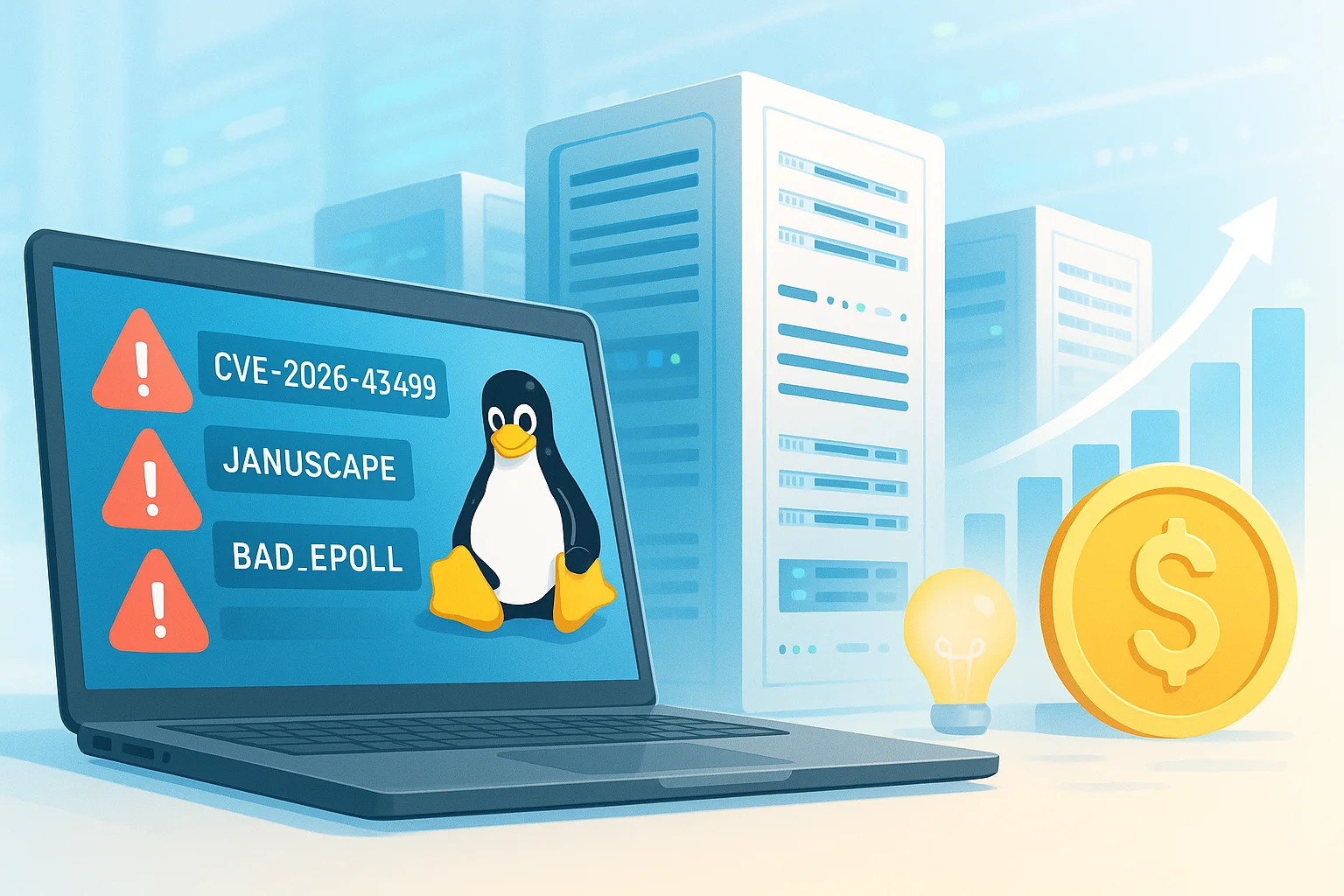
Critical Linux vulnerabilities (CVE-2026-53359, CVE-2026-43499) enable cross-tenant escape and privilege escalation in shared hosting and public cloud. The isolation wall between tenants is compromised, forcing urgent industry-wide patching.
DigitalOcean's backlog surged 10x in Q2, driven by nine-figure AI infrastructure contracts. The cloud-for-developers company is pivoting toward enterprise AI workloads and away from hourly billing.
SK Hynix's record Nasdaq IPO raises $26.5B for HBM fabs, capitalizing on AI demand surge. CEO simultaneously warns 2027 will be worst year for memory shortage, with crunch lasting until 2030.
Across 2025-2026, cloud platforms and hosts are eliminating free tiers without loud announcements. The quiet repricing threatens the developer pipeline and shifts AI infrastructure economics.
GoDaddy warns self-managed VPS customers of critical GhostLock Linux kernel vulnerability (CVE-2026-43499) affecting nearly all Linux servers. Patching is customer responsibility, not provider-managed.
Security & Compliance
Critical Linux vulnerabilities (CVE-2026-53359, CVE-2026-43499) enable cross-tenant escape and privilege escalation in shared hosting and public cloud. The isolation wall between tenants is compromised, forcing urgent industry-wide patching.
Three separate security flaws disclosed in early July across WordPress plugins, CMS, and hosting stack share one cause: improper input validation. Web-hosting-layer security remains inconsistent.
GoDaddy warns self-managed VPS customers of critical GhostLock Linux kernel vulnerability (CVE-2026-43499) affecting nearly all Linux servers. Patching is customer responsibility, not provider-managed.
Januscape (CVE-2026-53359) is a guest-to-host escape flaw in Linux KVM/x86 hypervisors. Hosting providers face critical patching obligation to prevent tenant breakout.
Cloud & Infrastructure
DigitalOcean's backlog surged 10x in Q2, driven by nine-figure AI infrastructure contracts. The cloud-for-developers company is pivoting toward enterprise AI workloads and away from hourly billing.
Pricing & Business
Across 2025-2026, cloud platforms and hosts are eliminating free tiers without loud announcements. The quiet repricing threatens the developer pipeline and shifts AI infrastructure economics.
Public filings reveal hosting companies are shedding low-margin customers at scale. The economics of acquiring and retaining small-account customers has become unsustainable for public providers.
Acquisitions & Market
SK Hynix's record Nasdaq IPO raises $26.5B for HBM fabs, capitalizing on AI demand surge. CEO simultaneously warns 2027 will be worst year for memory shortage, with crunch lasting until 2030.
SK Hynix CEO warns memory shortage will worsen in 2027 and persist until 2030, even as the company raises record capital. AI demand is outpacing DRAM and HBM supply expansion.
Huawei's Ascend 950 chips and Atlas SuperPods target South Korea's AI market with aggressive pricing and tripled inference vs. Nvidia H20. Geopolitical chip competition is intensifying.
Domains & DNS
GoDaddy told Delhi High Court that India's domain-privacy ruling could force it and other registrars out of the country. Regulatory pressure over WHOIS disclosure is reshaping regional compliance.
Technology & Tools
Hostinger integrated Patchstack vulnerability scanning for npm dependencies into Node.js hosting by default. Web hosts are now treating application-dependency security as standard, not premium.
JEDEC's SPHBM4 standard promises HBM4-class bandwidth without silicon interposers, cutting packaging costs. The narrower 512-bit interface reduces interposer expense while maintaining performance.
Extendify released Code, a white-label AI site-building platform for hosting companies. The move brings generative coding to the hosting industry as a bundled value-add for customers.
Other News
Ireland's datacenter power consumption rose another 10% to 23% of national electricity supply, while grid connection restrictions persist around Dublin. Infrastructure bottlenecks constrain further growth.
Microsoft's emissions jumped 25% year-over-year due to AI datacenter expansion. The company faces a quandary balancing environmental goals with aggressive AI infrastructure investment.
North Carolina repealed the sales tax exemption on datacenter electricity while preserving equipment incentives. Policy shift reflects changing priorities as AI power demand reshapes state economics.
Oregon approved a 29.7% datacenter power rate hike under the POWER Act for users above 20 MW, offsetting residential rate cuts. Regulatory pressure on large industrial power users is accelerating.
Korean V-Die and Japanese MOSAIC HBM designs promise sideways stacking to improve cooling, bandwidth, and capacity. Novel thermal solutions address AI memory's heat bottleneck.
Meta's 1 GW Alberta AI campus reveals hyperscalers now secure transmission and power commitments years before announcing projects. Grid capacity is the primary constraint on AI infrastructure.
Days after QTS abandoned its $30B Digital Gateway project, county supervisors rejected another 43-million-square-foot datacenter campus. Permitting and community opposition now rival power as deal-makers.
Cisco Live 2026 experts warned AI growth demands a networking supercycle. Networks are now as critical as GPUs and power for hyperscale datacenter viability.
UK government ruled nationally significant infrastructure projects, including datacenters, can bypass local council approvals. The move cuts permitting timelines by a year and saves $1B+ in NIMBY costs.
UK overhaul of planning rules allows datacenters to bypass local opposition and cut timelines. Regulatory streamlining signals government commitment to AI infrastructure acceleration.
Texas's first extra-high-voltage transmission network marks a paradigm shift: building massive grid capacity ahead of datacenter deployment. Infrastructure precedes demand, not vice versa.
QTS withdrew its $30B Digital Gateway despite strong infrastructure, showing permitting certainty and community approval now rival power as AI datacenter deal-breakers.
QTS's $30B mega-datacenter project collapsed on a notice filing error, not market shifts or opposition. Regulatory and procedural barriers now rival technical feasibility.
Nvidia's Vera CPU claims 1.8x single-thread performance over x86 for agentic AI workloads. Next-gen Rigel Arm cores signal shift toward agent-centric architectures.
Nvidia's Kyber NVL144 rack slipped to 2028 due to PCB midplane issues. Delay underscores challenges scaling GPU density and cooling for next-gen AI clusters.
U.S. AI chip production starts and ends domestically, but critical packaging remains entirely offshore in Taiwan until 2028. America's AI supply chain relies on geopolitically fragile partnerships.