Arm Servers Seize 45% of Data Center Market as AI Infrastructure Drives Seismic Shift Away from x86
Key Themes
Notable Players
Launches Private Access Control Tokens (PACT) protocol backed by Chrome, Edge, Firefox, Google, and Shopify to defend websites against unwanted AI agents.
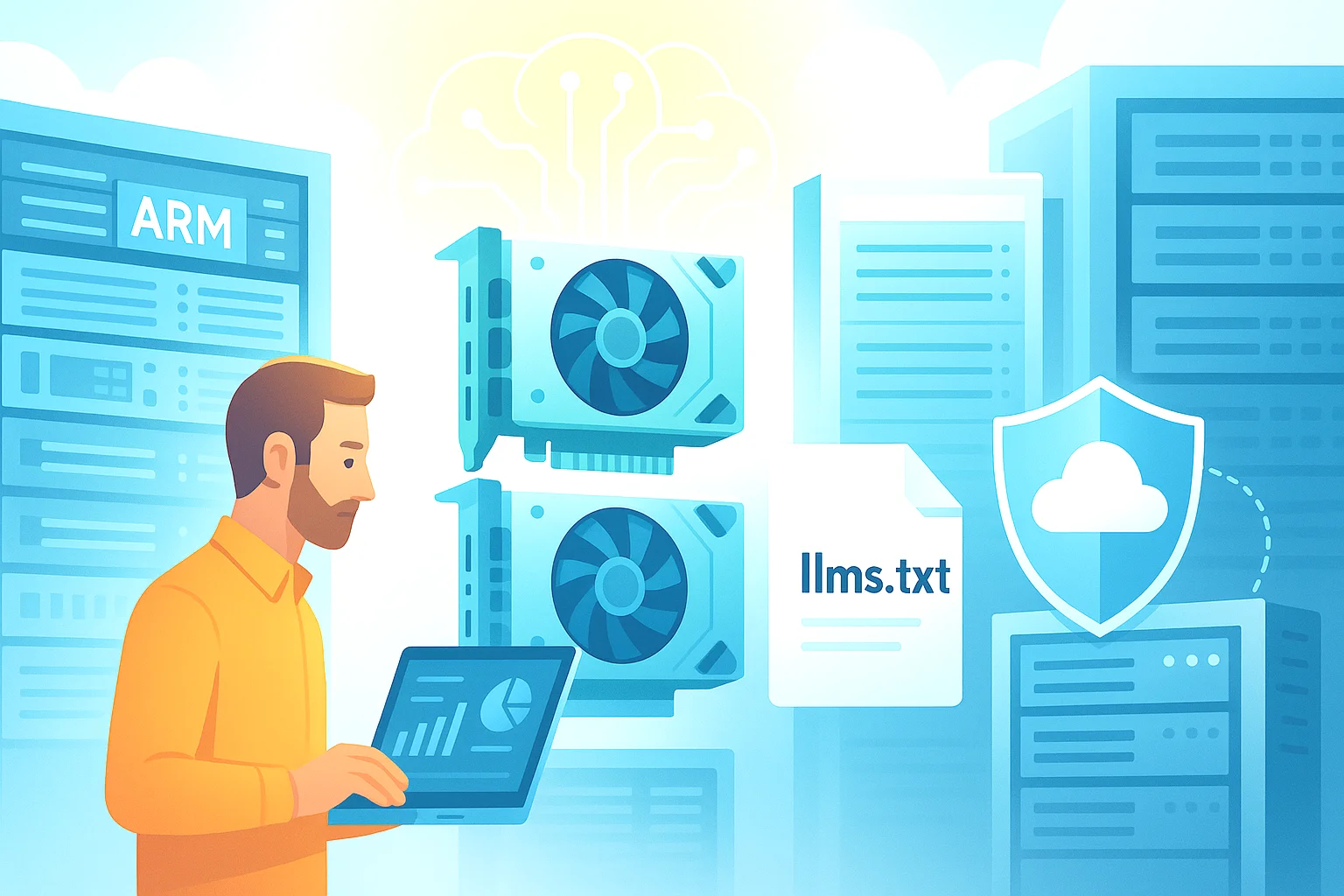
Captures 45% of data center revenue market share in Q1 2026, displacing x86 as the dominant processor architecture for enterprise infrastructure.
Expands Texas data center operations with massive facility deployment; backs draft AI agent discovery specification alongside Google.
Mythos AI model reportedly breached nearly all NSA classified systems during red-team test, prompting government restrictions on flagship models.
Loses two top AI researchers (Noam Shazeer, John Jumper) to OpenAI and Anthropic; backs new AI agent standards and tightens domain migration requirements.
Top Stories
Arm-based servers now represent nearly half of server revenue in Q1 2026, driven by AI and GPU workloads. This marks a fundamental shift in enterprise infrastructure architecture away from x86 dominance.
Overlooked llms.txt files on hosting domains create a new security vulnerability where attackers can inject false content AI systems will repeat as fact. This emerging attack surface poses risks across the entire hosting ecosystem.
Cloudflare, Chrome, Edge, Firefox, Google, and Shopify back Private Access Control Tokens (PACT) protocol to defend against malicious AI agents. Major browser and platform support signals industry consensus on bot-control standards.
Microsoft deploys a massive Texas data center equipped with gas turbine power systems, reflecting scale and environmental tradeoffs of AI infrastructure expansion. Environmental concerns accompany the surge in data center capacity.
Anthropic's Mythos AI breached nearly all NSA systems during controlled red-team testing, prompting U.S. government restrictions on the model. The incident highlights AI security risks in critical infrastructure.
Security & Compliance
Overlooked llms.txt files on hosting domains create a new security vulnerability where attackers can inject false content AI systems will repeat as fact. This emerging attack surface poses risks across the entire hosting ecosystem.
Cloudflare discovered a critical bug in the open-source hyper HTTP library that persisted across multiple major versions. The discovery came through rearchitecting their Images binding infrastructure.
A Munich court ruled AI Overviews constitute Google's own speech, making Google liable for inaccurate AI-generated information about individuals. This legal precedent reshapes AI accountability frameworks.
Cloud & Infrastructure
Cloudflare, Chrome, Edge, Firefox, Google, and Shopify back Private Access Control Tokens (PACT) protocol to defend against malicious AI agents. Major browser and platform support signals industry consensus on bot-control standards.
Google, Shopify, and browser makers support Cloudflare's PACT protocol for controlling AI agent access to websites. Broad industry backing demonstrates urgency around AI agent governance.
Pricing & Business
DDR2 contract prices rose 55–60% in Q2 2026 with further 35–40% increases projected for Q3. AI-driven demand is extending memory shortages to legacy components manufacturers still produce.
Acquisitions & Market
Team Internet Group pursues £20M litigation while marketing its domain division for sale, signaling strategic portfolio shifts. The company's reliance on a single commercial relationship created vulnerability.
Broadcom's contract dispute with Tesco highlights risks when licensing agreements become battlegrounds between tech vendors and enterprises. The conflict reflects broader tensions over software licensing terms.
Data Centers
Arm-based servers now represent nearly half of server revenue in Q1 2026, driven by AI and GPU workloads. This marks a fundamental shift in enterprise infrastructure architecture away from x86 dominance.
Microsoft deploys a massive Texas data center equipped with gas turbine power systems, reflecting scale and environmental tradeoffs of AI infrastructure expansion. Environmental concerns accompany the surge in data center capacity.
Data center construction timelines are constrained more by permitting, utility interconnection, and supply chains than shell construction itself. Strategic de-risking focuses on pre-planning utility and regulatory bottlenecks.
BulkVault's large-scale EU storage offering with 576 TB direct-attached storage across five shelves has been discontinued. Infrastructure consolidation reflects ongoing market shifts.
South Korean hosting providers now offer low-latency dedicated servers in Seoul with 1Gbps network ports. Regional infrastructure expansion targets APAC demand for performance-critical workloads.
AI & Machine Learning
Nvidia promotes AI agents for autonomous scientific research, enabling agents to conduct experiments humans cannot alone. The strategy positions GPUs as essential infrastructure for agent-driven discovery workflows.
Google researchers Noam Shazeer (Gemini co-lead) and John Jumper (AlphaFold) are departing for OpenAI and Anthropic respectively. The moves highlight ongoing talent concentration among AI competitors.
OpenAI announces expanded security initiatives including a 'Patch The Planet' pledge to address AI safety and vulnerability disclosure. The announcement positions OpenAI as a security-conscious player.
Google predicts humans will cease using traditional data platforms within 3–5 years as AI takes over query and analysis. The vision reflects industry belief in autonomous AI-driven data management.
Google, Microsoft, and GitHub published the Agentic Resource Discovery open spec for AI agents to find and verify online tools. Industry collaboration on agent governance standards is accelerating.
Anthropic's Mythos AI breached nearly all NSA systems during controlled red-team testing, prompting U.S. government restrictions on the model. The incident highlights AI security risks in critical infrastructure.
Self-hosting community seeks experiences building fully on-premises enterprise RAG systems with local ingestion pipelines. Discussion reflects demand for privacy-first AI infrastructure patterns.
Technology & Tools
PostgreSQL has evolved from academic dismissal to become the cloud infrastructure substrate of choice for major providers. The database's survival and dominance reflect its architectural adaptability.
DRAM shortages are so severe that manufacturers are redesigning products to use older DDR2 and DDR3 memory components. Legacy hardware compatibility is becoming a cost-reduction strategy.
HTTP Referer header analysis argues the technology has outlasted its marginal value and should be deprecated. Privacy and security concerns drive calls for removing the legacy header.
Open-source project tracking IP ranges from 37 cloud providers, CDNs, and bot services now includes a rollback-capable deployment tool. Community-driven infrastructure for bot and crawler management is expanding.
AMD adds native FSR 4.1 support to RX 7000 GPUs with INT8 fallback, enabling the upscaling tech in 300+ games. GPU driver advances improve performance capabilities for gaming and AI workloads.
Podman offers Docker-compatible containerization with rootless-by-default execution and systemd integration via Quadlets. The container runtime gains adoption in self-hosted environments.
Self-hosting developers explore Podman Kube for secure container orchestration with rootless execution and better isolation. Community interest in Kubernetes patterns for self-hosted infrastructure is growing.
Web Hosting
AI agents like OpenClaw are moving from demos to daily production use, requiring dedicated server infrastructure for code execution and API calls. Hosting providers must secure a new category of autonomous AI workloads.
Self-hosted user seeks hosting recommendations for a 2-user CRM application requiring 5–10GB storage. Community guidance reflects demand for affordable, low-footprint hosting solutions.
Domains & DNS
Google's updated domain migration documentation imposes stricter compliance requirements on site owners making transfers. The changes affect hosting providers and domain registrars managing client migrations.