Security dominates July as WordPress core flaw, cPanel exploits, and Linux escapes force industry patching sprint—while AMD GPU investments and AI infrastructure deals reshape the competitive landscape
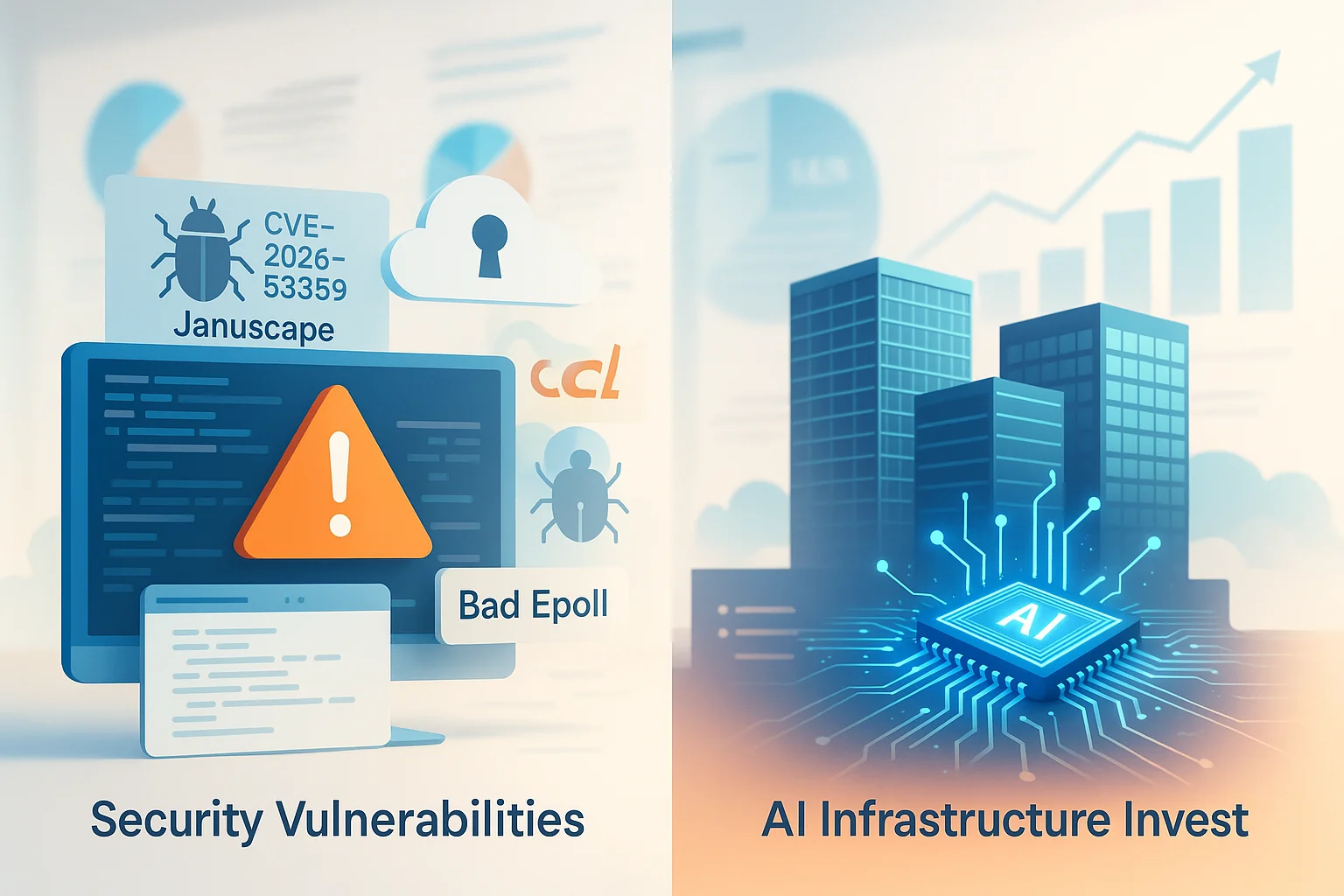
By the Numbers
- 2,143 total articles published in July across tracked sources (412 in W26, 471 in W27, 201 in W28, 597 in W29, 462 in W30)
- Security vulnerabilities: WordPress (unauthenticated RCE), cPanel (cross-account escapes), Linux kernel (Januscape, Bad Epoll), Nginx (CVE with 9.2 CVSS), KVM (16-year-old escape)
- AI infrastructure: AMD-Anthropic $5B deal, SK-Nvidia $500B partnership, Meta Hyperion 5 GW campus, OpenAI-SoftBank 10 GW Ohio negotiation, AWS $220B capex commitment
- M&A activity: 30 major deals in H1 2026; Green Olive Tree acquired ZebraHost ($1.1M), Infomaniak IPO announced, Automattic acquired WebHosting.com
- Pricing pressure: 65 basis points of renewal price hikes, Leaseweb VPS nearly doubled on cheapest tier, customer acquisition cost inflation despite channel deterioration
- Regulatory: UK FCA placed AWS, GCP, Azure, Oracle under critical third-party oversight; GoDaddy threatened India exit over domain privacy ruling; ICANN gTLD application window opens August 12
Major Players
Positioned as edge-compute and AI-traffic-filtering leader. Launched Monetization Gateway for resource charging, introduced AI search smarter initiative, and expanded self-hosted security rules. High relevance (0.65) but sentiment mixed (0.48 positive), indicating technical strength with user adoption friction.
Dual pressures: regulatory (threatened India exit over domain privacy ruling), brand protection (anti-trademark tools), and SMB positioning. Sentiment neutral (0.0) despite high mention volume, suggesting commodity perception despite breadth of offerings.
Security crisis anchor: CVE-2026-41940 exploited via GitHub Actions, cross-account escapes (July 29), validation shortcut flaws. Mentions concentrated in provider forums and incident response contexts. Negative sentiment (-0.14) justified by ongoing patch burden.
Bifurcated narrative: capital-aggressive ($220B capex lift), but geopolitically constrained (Bahrain offline for months, UAE reduced capacity due to US-Iran tensions). Meta compute competition emerging. Negative sentiment (-0.38) reflects infrastructure anxiety.
Standout performer: landed multiple nine-figure AI deals, backlog jumped tenfold, launched managed Weaviate for inference, announced GPU pricing updates. Inference-first strategy resonating. Limited mentions due to niche positioning but positive when cited.
Annual pricing revision, AMD Helios MI455X deployment announced at scale, Canonical Kubeflow managed service. Mid-ranking mentions reflect stable-but-incremental positioning vs. AWS and GCP.
18.0.79 release with security audit findings, REST API expansion, SQL Server 2025 support. Positive sentiment (0.17) from control-panel operators seeking hardened alternatives to cPanel during crisis.
Patched Januscape across 1 million VMs over week-long window, demonstrating scale but also operational burden. Faced criticism for account deletion policies and support quality. Market rumors of acquisition or restructuring.
Announced IPO via reverse merger into Perrot Duval Holding on SIX Swiss Exchange, positioning as privacy-first European alternative to hyperscalers. Significant strategic move for 30-year-old operator seeking capital without losing autonomy.
Industry Health
The hosting industry enters August in a state of managed crisis. Economically, growth drivers remain intact: AI demand stretches into 2028 with capacity-constrained supply, hosting providers report nine-figure AI deals (DigitalOcean), and M&A volume exceeds 30 transactions in H1 alone. However, the underlying financial model shows stress. Customer acquisition costs are inflating even as the channels that deliver them deteriorate—a dynamic buried in Q2 earnings filings but critical to long-term sustainability. Renewal multipliers range from 1.0x to 5.3x with no evident cost justification, suggesting operators are using price increases as margin offset rather than cost recovery. Energy and hardware costs remain elevated. The industry is investing heavily (AWS $220B capex, Meta $50B+ in Louisiana alone) but doing so asymmetrically: hyperscalers and well-capitalized AI-focused operators are pulling investment away from traditional shared hosting and mid-market cloud. This creates a bifurcated market where the top tier accelerates (Google Cloud 'is killing it,' per commentary) while regional and small providers face margin compression. The security crisis, while grave, may paradoxically stabilize the bottom by raising barrier to entry through compliance cost.
- Article volume peaked at 597 in W29, indicating July 29-30 news intensity correlated with major security patches and Amazon earnings
- Sentiment distribution: 66.5% neutral suggests detached, transaction-focused coverage; only 14.5% positive despite massive AI deals
- AI infrastructure dominance: 'ai-infrastructure' (avg relevance 0.77), 'ai-hardware' (0.74), 'data-center' (0.74) scored highest relevance
- Consolidation underway: 30 deals in first half, from $1.1M ZebraHost acquisition to potential $40B Aligned deal (BlackRock AIP), indicating both roll-up and distressed activity
- Pricing elasticity broken: Leaseweb entry tier doubled (+100%) while mid-tier unchanged, suggesting loss-leader abandonment
- Regional divergence: UK government offers data center 'national importance' status to bypass local approval—accelerating hyperscaler infra, not mid-market
Technology Trends
AI infrastructure irreversibly dominates July's technology conversation, but with a critical twist: the infrastructure is no longer speculative. AMD and Nvidia announced concrete production schedules for next-gen accelerators (MI455X, MI450, SK partnership supplying 2 GW by H1 2027). Meta's Hyperion campus, originally 2 GW, expanded to 5 GW with grid-infrastructure implications—a scale that influences utility planning, not just enterprise capex. WordPress 7.0 'Armstrong' embedded AI natively into the platform rather than treating it as a plugin ecosystem, signaling a fundamental platform shift. This cascades down: cPanel, Plesk, and shared hosting control panels now inherit security responsibility for AI-assisted workflows. Security technology occupied the other half of the narrative: WordPress core flaws broke the plugin-centric assumption that drove the industry for 20 years. Linux kernel escapes (Januscape, Bad Epoll) shattered tenant isolation assumptions in both shared hosting and public cloud, forcing architectural rethinks in multi-tenant orchestration. Nginx vulnerability (CVE with CVSS 9.2, sitting since 2011) revealed that edge-compute providers cannot rely on upstream stability. The technical message is clear: 2026 is the year the security perimeter shifted from application layer (plugins) to platform and kernel, and the industry is not ready. Tools like GitHub Actions became an adversary surface (cPanel exploit delivery mechanism), and GitOps now carries both speed and risk implications. Control-panel vendors responded with hardened releases, but at the cost of feature velocity.
- AI infrastructure topics highest relevance: 'ai-infrastructure' (0.77), 'ai-data-centers' (0.83), 'ai-hardware' (0.74), 'ai-demand' (0.75)
- Concrete GPU deployments: AMD MI455X, MI450; SK hynix record $26.5B US IPO for HBM fabs; Nvidia guaranteeing OpenAI $250B financing for 10 GW Ohio campus
- WordPress 7.0 Armstrong platform shift: native AI, block editor redone, removal of classic editor—forces all hosters to support AI-assisted content workflows
- Security escalation: 'vulnerability' (0.66 relevance, -0.83 sentiment), 'cve' (0.77, -0.8), 'malware' (0.53, -0.86), 'breach' (0.41, -1.0)
- Kernel and hypervisor flaws: Januscape (KVM, 16 years old), Bad Epoll (Linux privilege escalation), Nginx CVSS 9.2 (2011 origin)
- GitOps weaponization: GitHub Actions abused for cPanel CVE-2026-41940 exploitation, demonstrating CI/CD-as-attack-surface
- Control-panel platform maturity: Plesk REST API expansion, cPanel focus on security audit vs. new features, DirectAdmin gaining mention in forum discussions
Business Trends
The hosting industry's business model faces structural pressure from three simultaneous forces: margin compression via price hikes that customers increasingly resist, acquisition costs inflating while distribution channels deteriorate, and capital intensity reshaping who can compete. July's earnings calls and filings revealed that customer acquisition cost (CAC) is climbing at the exact moment the machinery for acquiring customers—ad networks, affiliate channels, SEO—is breaking down. This is not cyclical; it reflects Google's algorithm shifts (AI Overviews cannibalizing organic traffic), platform consolidation (fewer brand partnerships available), and the platform shift to owned media (Discord communities, newsletters) which is harder to scale for SMB providers. Pricing, the visible pressure point, shows increasing stratification. Leaseweb's VPS pricing (entry tier nearly doubled while mid-tier flat) confirms providers are abandoning loss-leaders and retreating upmarket. Renewal multipliers from 1.0x to 5.3x, documented in June's Renewal Multiplier Index, appear justified by hardware/energy costs, but the underlying issue is utilization: providers paid for AI-capable infrastructure (GPU, high-memory nodes) that traditional workloads do not fill. This creates a pricing arbitrage: commodity storage/shared hosting becomes unprofitable; AI inference workloads are booked years ahead at margins high enough to offset infrastructure cost. M&A volume (30 deals in H1) reflects distressed consolidation as much as roll-up appetite. GreenOlive Tree's $1.1M ZebraHost acquisition is illustrative: at 2x revenue multiple, it indicates market for regional/legacy operators willing to exit. Infomaniak's IPO, conversely, signals confidence in independent, privacy-first positioning—but as a European exception, not the rule. The coming 6-12 months will sort winners from distressed operators more sharply than the past decade.
- CAC inflation paradox: documented in Q2 earnings, costs rising while channels (SEM, affiliate) degrade due to platform algorithm shifts
- Renewal Multiplier Index (June): 1.0x to 5.3x variance with no cost correlation, indicating operator discretion rather than cost recovery
- Pricing stratification: Leaseweb $3.50→$6.99 (entry), flat mid-tier; observed in reseller hosting, shared hosting, entry-level VPS
- M&A velocity: 30 deals H1 2026 including $1.1M ZebraHost (regional), potential $40B Aligned (hyperscale), BlackRock AIP entering infrastructure ownership
- Capital intensity shift: AWS $220B, Meta $50B+ Louisiana, hyperscalers pulling investment away from traditional cloud (GCP, Azure upmarket)
- Distribution channels under pressure: SEO/organic traffic declining post-AI Overviews, affiliate networks saturated, owned media (Discord, email) hard to scale for SMB
- Margin structure unsustainable at scale: shared hosting + traditional VPS cannot absorb hardware costs; AI inference becomes only profitable segment
Market Movements
July recorded 30 major M&A transactions in the hosting sector, continuing H1 2026's consolidation pace, but with new patterns emerging. At the top of the market, the largest data-center transaction in history appears imminent: BlackRock-led AIP's approximately $40B purchase of Aligned cleared final approvals, signaling institutional capital's permanent entry into infrastructure ownership. This is not a hosting company buying a hosting company; it is a financial player buying the physical and economic substrate on which hosting runs. Mid-market moves were more fragmented: Green Olive Tree acquired ZebraHost for $1.1M (reported as doubling revenue), HostPapa made multiple acquisitions on different theses in successive weeks, and HOSTAFRICA pursued regional consolidation. Infomaniak announced an IPO via reverse merger, seeking to preserve independence while raising capital for AI infrastructure buildout. Automattic, the WordPress company, acquired WebHosting.com, extending its hosting portfolio beyond Pressable. The message across these deals: traditional hosting economics no longer support independence for all but the largest or most specialized operators. Regional and niche players are consolidating or exiting; hyperscalers and venture-backed platforms (Pressable, DigitalOcean) are acquiring complementary capabilities (managed services, inference, WordPress tools). Pricing remained a secondary deal driver (most transactions private, valuations opaque), but customer acquisition cost inflation and churn acceleration are implicit in the transaction multiples—deals at lower revenue multiples (ZebraHost, rumored regional ops) suggest distressed conditions. The geopolitical backdrop (AWS regions offline, Iran-US tensions) adds urgency to multi-region consolidation and sovereignty-aware hosting (Infomaniak, regionalized cloud offerings).
- Hyperscale M&A: BlackRock AIP ~$40B Aligned acquisition (largest data-center deal in history, clears approvals July)
- Mid-market acquisitions: Green Olive Tree buys ZebraHost $1.1M (2x revenue multiple, veterinarian-owned provider expansion), HostPapa multi-deal strategy, HOSTAFRICA regional roll-up
- Platform consolidation: Automattic acquires WebHosting.com, extending hosting portfolio; Pressable (Automattic lab) lands AI deals
- IPO activity: Infomaniak (Swiss host, 30-year-old) announces reverse merger IPO on SIX to fund AI buildout while preserving independence
- Regulatory reshaping deals: UK 'national importance' status for data centers accelerates hyperscaler infra, slows mid-market competition; ICANN gTLD round (Aug 12 close) at $227K/app signals consolidation (only large operators can afford)
- Geopolitical factor: AWS region offline (Bahrain) months, UAE reduced—incentivizes multi-region redundancy, favors large operators with regional coverage
- Valuation signal: lower multiples on distressed/regional ops vs. AI-focused platforms (DigitalOcean, hyperscalers), indicating bifurcation in buyer appetite
Outlook
August and September will test whether the security crisis of July translates into operational or market disruption. WordPress forced updates via auto-update mechanism may have eliminated most exploit exposure, but cPanel remains a slow patch target (many managed providers batch updates quarterly, some annually). Organizations running unpatched cPanel or vulnerable WordPress instances will face active exploitation risk through September. Parallel to this, AI infrastructure competition will shift from announcement phase to production deployment: AMD's 1 GW MI450 comes online H1 2027, SK hynix fabs begin HBM shipments, and SoftBank's Ohio campus enters construction phase. This suggests cloud pricing for inference workloads will stabilize or decline in Q4 2026 as capacity arrives, pressuring DigitalOcean and other inference platforms to choose between volume-based margin compression or customer concentration. The ICANN gTLD application window closes August 12; expect 200+ applications, most from large operators and financial syndicates. Few regional hosters can afford the $227K application fee, concentrating new TLD control further upmarket. WordCamp US (August 16-19) and HostingCon (August 19-21) will reveal whether WordPress 7.x adoption is driving hosting upsell or commoditizing it. Finally, regulatory convergence continues: UK Critical Third Party oversight (AWS, GCP, Azure, Oracle) begins enforcement; expect audits, compliance costs, and potential service disruptions as cloud providers retrofit controls. GoDaddy's India threat to exit over domain privacy ruling may not resolve until Q4, but will incentivize registrar consolidation in emerging markets. By October, the industry will have clarity on whether July's security crisis was a one-month pain event or a structural reckoning.
- WordPress patching: forced auto-updates mitigated critical exposure, but plugin ecosystem (millions of sites) still patching; July 29 cPanel cross-account escapes likely to remain unpatched in 10-15% of environments through Q3
- AI capacity inflection: MI450 1 GW H1 2027, HBM fabs ramping, SoftBank Ohio construction begins—supply-driven margin pressure on inference inference in Q4 2026
- ICANN gTLD applications close August 12 with ~200 expected applications; only large operators/syndicates afford $227K fees; expect further DNS/domain consolidation
- WordCamp US (Aug 16-19) and HostingCon (Aug 19-21) will surface WordPress 7.x adoption rates and hosting upsell velocity
- Regulatory: UK CTP enforcement begins; GoDaddy India ruling unresolved, expect domain registrar consolidation; GDPR/data sovereignty rules favor regional clouds (Infomaniak, regional hosters)
- Churn and acquisition: DigitalOcean backlog may cool as customer concentrates on setup/deployment (9-figure deals likely enterprise); SMB cloud migration may decelerate if acquisition costs remain elevated
- Consolidation continues: by year-end, expect 10-15 additional mid-market deals as Q3 earnings reveal CAC/churn acceleration
Top Stories
Three months after cPanel's critical CVE-2026-41940 authentication bypass, a malware operation is actively exploiting it via GitHub Actions automation, demonstrating that the bug's reach extends beyond standard patching and detection mechanisms into the CI/CD pipeline.
Why it matters: Signals that security flaws in control panels are not static: once patched, they persist in unpatched instances, but the delivery mechanism now includes GitHub's own infrastructure. This forces hosters to audit customer repositories, a new operational burden. Indicates the hosting stack's integration with development tooling has created novel attack surface.
WordPress 7.0.2 security release addressed a critical, unauthenticated code-execution chain (wp2shell) in core code, not plugins. The vulnerability allowed attackers with zero accounts to take over stock installations. WordPress forced updates via auto-update mechanism on July 17, but the gap between patched and safe remains large for plugin-dependent sites.
Why it matters: Represents a structural break in WordPress security assumptions: the industry has relied on plugin isolation, but core flaws eliminate that boundary. The auto-update mechanism worked, but exposed the massive plugin ecosystem's vulnerability to cascade failures. Hosters must now ensure plugin updates and compatibility testing are automated, raising operational complexity and SLA commitments.
Two separate Linux kernel vulnerabilities disclosed in early July: CVE-2026-53359 (Januscape, in KVM) and a privilege-escalation flaw (Bad Epoll) both enable single tenants to escape their container/VM boundary and compromise entire servers. OVH spent a week patching across 1 million VMs.
Why it matters: Shattered the fundamental assumption underlying shared hosting and public cloud: that the wall between tenants holds. These are not plugin, application, or control-panel flaws but kernel-level escapes. Requires hypervisor and OS patches in lockstep, raising cost for managed providers and creating ongoing compliance risk. Multi-tenant economics become more expensive as security demands increase.
Analysis of 30 M&A transactions in hosting sector H1 2026, from $1.1M ZebraHost acquisition to $40B Aligned deal. Identifies two competing clock speeds: venture-backed platforms consolidating complementary services (Automattic, DigitalOcean), and hyperscalers/financial players buying infrastructure at utility scale.
Why it matters: Documents the bifurcation of the industry. Traditional hosting consolidation (operator-to-operator) is slower and smaller; financial and platform consolidation dominates volume and value. Suggests independent mid-market operators face binary choice: exit or be consolidated within 24 months.
DigitalOcean reported multiple nine-figure annual commitments for AI inference and training workloads, with backlog jumping 10x. Company's inference-first pivot is validating, attracting enterprise customers previously unavailable to SMB cloud platforms.
Why it matters: Demonstrates that AI infrastructure is reshaping cloud provider positioning. DigitalOcean, traditionally a developer-first cheap-cloud platform, is now enterprise-grade via inference workloads. Validates the thesis that AI workloads command pricing power and long-term commitments, offsetting the need for traditional shared hosting and entry-level VPS margins.
Public filing analysis reveals that customer acquisition cost is inflating at the moment the channels for acquiring customers are breaking down. Large hosting and web-presence companies report declining customer growth despite rising CAC, indicating fundamental shift in market saturation or channel effectiveness.
Why it matters: Identifies the financial unsustainability of traditional hosting business model at scale. Rising CAC + declining organic traffic (post-Google algorithm) + channel saturation = margin pressure. Explains why consolidation is accelerating: only operators at top of scale or with differentiated (AI, managed WordPress, infrastructure) positioning can afford CAC inflation.
AMD announced a $5 billion investment and 2-gigawatt MI450 GPU supply commitment to Anthropic, with first GW coming online H1 2027. Represents largest non-Nvidia GPU deployment and signals competitive AI chip market emerging.
Why it matters: Breaks Nvidia's hardware monopoly in AI, validating alternative accelerators (AMD, Intel Gaudi) as viable. Means cloud pricing for inference will stabilize/decline in late 2026 as competing capacity comes online. Allows cloud providers like DigitalOcean and Azure to diversify supply and negotiate lower GPU costs, improving margins.
Swiss hosting and cloud provider Infomaniak announced IPO via reverse merger into Perrot Duval Holding on SIX Swiss Exchange, preserving founder control while raising capital for AI infrastructure and European expansion.
Why it matters: Signals that independent, privacy-first, non-US hosting operators can access capital without exiting. Infomaniak's 30-year track record and European positioning made this possible, but it remains an exception. Highlights the regulatory/geopolitical angle: GDPR compliance, US exposure avoidance, and sovereign cloud positioning are becoming capital-raising narratives, not commodities.
Bank of England, Prudential Regulation Authority, and Financial Conduct Authority began jointly overseeing AWS, GCP, Azure, and Oracle as Critical Third Parties to UK financial system on July 13. Subjects cloud providers to banking-grade regulatory compliance.
Why it matters: Marks structural regulatory shift: cloud providers are now systemically critical infrastructure, not just commercial services. Compliance costs will rise, outages will trigger regulatory investigation, and audit burden will increase. Drives hyperscalers upmarket (compliance-heavy enterprise) and creates opportunity for regional/sovereignty-focused clouds (Infomaniak, Gaia-X participants) to position as lower-compliance alternatives for non-financial workloads.
After 14-year legal battle, Verisign's .web TLD was added to the root zone on July 22, with no price cap unlike .com. Signals ICANN's shift toward market-driven pricing and opens window for TLD application round (closes August 12) with $227K entry fee per application.
Why it matters: Concentrates TLD ownership among large operators who can afford $227K/application and ongoing compliance. Smaller registrars and regional hosters will be excluded from TLD speculation/ownership, reducing their diversification options. Reinforces consolidation trend: only top-tier operators control critical internet infrastructure (TLDs, registries) going forward.