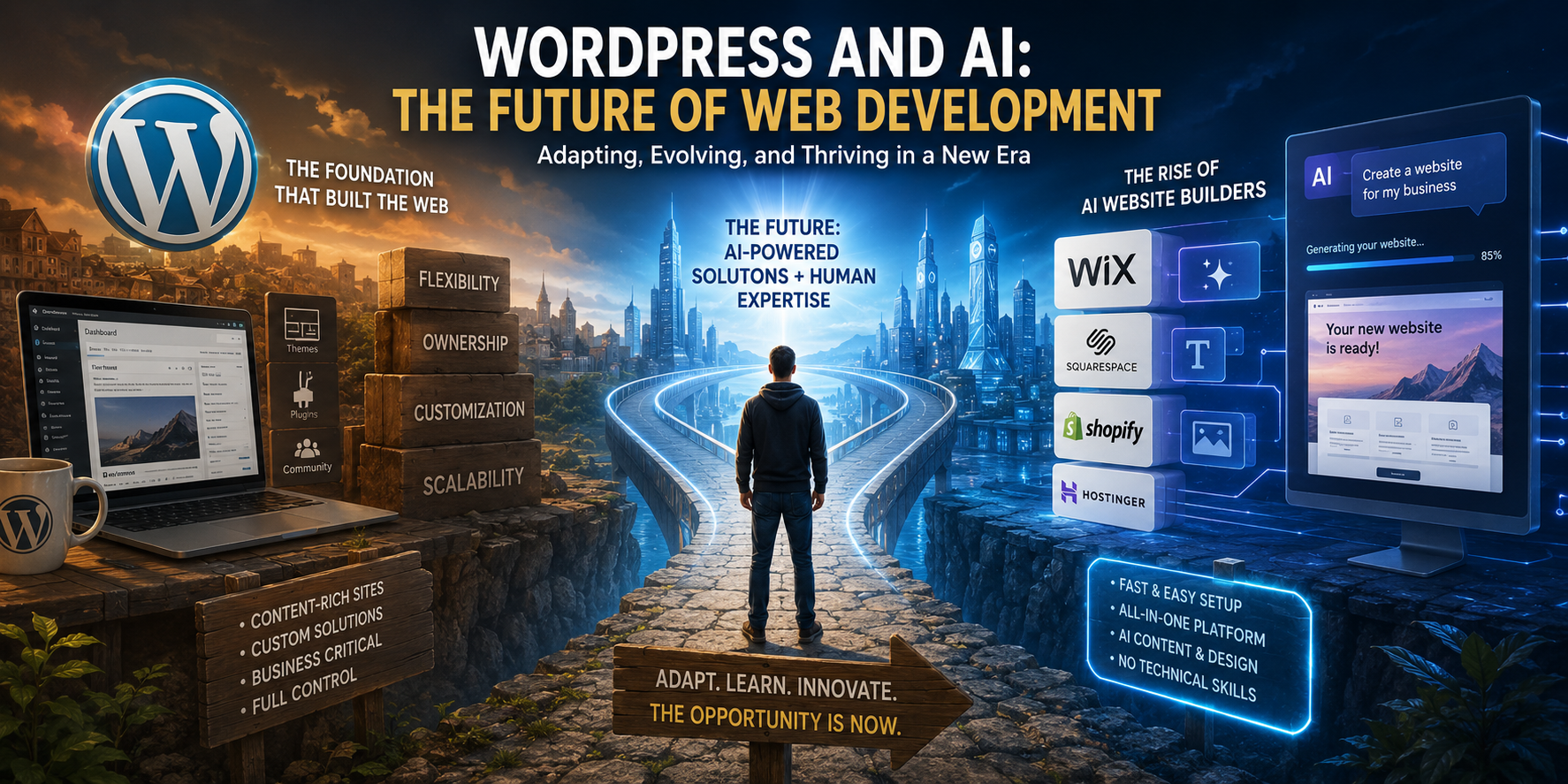
For more than two decades, WordPress has been one of the dominant forces in website development. It helped transform website creation from a specialized programming task into something accessible to designers, agencies, small businesses and technically inclined entrepreneurs.
WordPress also supported an enormous secondary economy. Hosting companies created WordPress plans. Independent designers built client websites. Plugin and theme companies sold extensions. Maintenance agencies managed updates and security. Resellers purchased hosting accounts and divided them among local business customers.
Artificial intelligence is now disrupting every part of that arrangement.
A business owner can describe a company to an AI website builder and receive a working website containing pages, text, images, navigation and calls to action in minutes. Platforms such as Wix, Squarespace, Hostinger, GoDaddy and Shopify are integrating AI directly into their onboarding, design, content and ecommerce systems.
Does that mean WordPress, traditional hosting and professional web design are approaching the end?
Probably not. However, the market is entering a major restructuring. WordPress will likely remain a large and important platform, but the easiest and least differentiated parts of the WordPress economy will come under increasing pressure.
WordPress remains enormously influential
As of June 2026, W3Techs reports that WordPress is used by approximately 41.5 percent of all websites and holds about 59.3 percent of the market among websites using a recognized content-management system.
That is an extraordinary installed base. It includes small business websites, news publishers, corporate sites, ecommerce stores, government organizations, membership systems, educational platforms and custom applications.
A platform of that size does not disappear quickly. Millions of organizations have invested in WordPress themes, plugins, content, staff training, custom development and hosting infrastructure. Migrating those websites to proprietary AI platforms would require time, money and operational risk.
WordPress therefore has considerable inertia working in its favour.
However, market dominance is not the same as guaranteed future growth. WordPress can remain the largest content-management system while gradually losing its share of newly created websites.
That is the most likely scenario: not a WordPress collapse, but a slow segmentation of the market.
AI is attacking the easiest part of web development first
The category most vulnerable to AI is the conventional small-business brochure website.
This normally includes:
-
a home page;
-
an about page;
-
descriptions of services;
-
a contact form;
-
testimonials;
-
a blog;
-
basic search-engine optimization;
-
perhaps appointment booking or a simple store.
For years, independent designers and small agencies could charge thousands of dollars to assemble these elements using WordPress and a page builder. The work still required design judgment and communication, but much of the production process involved selecting a template, changing colours, inserting content and configuring common plugins.
AI website builders can now perform much of that initial assembly automatically.
The customer answers questions about the business, preferred style, target customer and desired features. The system produces a draft website with structure, text and visual direction already in place. The owner can then make changes through an editor or conversational interface.
This does not necessarily produce a strategically strong or original website. It does, however, produce something that may be entirely adequate for a price-conscious local business.
That difference is critical. AI does not need to outperform the best web designer to disrupt the market. It only needs to provide an acceptable result more quickly and cheaply than an entry-level designer.
WordPress is more likely to evolve than disappear
WordPress still has important advantages that closed website-building platforms cannot easily reproduce.
A self-hosted WordPress customer can generally choose a hosting company, access the site’s files and database, install third-party extensions, modify the code, export content and move the site to another provider.
That degree of ownership and portability remains valuable.
WordPress can also support projects that extend well beyond a basic website. It can become a publishing platform, membership site, learning-management system, directory, customer portal, ecommerce store or content backend for another application.
The WordPress ecosystem contains an enormous number of plugins, integrations, developers and service providers. That ecosystem can be confusing, but it also makes WordPress adaptable.
Most importantly, WordPress can incorporate AI itself.
The future competition is therefore unlikely to be “AI versus WordPress.” It will be a contest between different AI-enabled platforms:
-
proprietary AI builders;
-
AI-assisted WordPress hosting;
-
AI-enhanced page builders;
-
ecommerce platforms with AI;
-
generated custom applications;
-
industry-specific website systems.
A customer may eventually describe a desired website to an AI assistant, while WordPress quietly operates underneath it. The user may never need to understand themes, plugins, caching or database management.
In that future, AI replaces the traditional method of building a WordPress site, but not necessarily WordPress as the underlying platform.
What this means for a career in web development
Web development is not disappearing, but career planning must change.
The most vulnerable professional is someone whose main skill is assembling conventional websites from templates. Basic page construction, routine CSS changes, stock-image selection and first-draft copywriting are becoming faster and less expensive.
A career built entirely around those tasks will face increasing price pressure.
The stronger career path is to move upward from production into problem-solving.
Valuable skills will include:
Business and conversion strategy
Companies do not ultimately need websites. They need leads, sales, bookings, donations, subscriptions, applications or customer engagement.
A developer or designer who can improve those outcomes has greater value than someone who merely creates pages.
Systems integration
Businesses need websites connected to customer-relationship management systems, accounting platforms, inventory, email marketing, analytics, payment processing, support desks and internal applications.
AI can assist with integration work, but the responsibility for selecting systems, handling data correctly and ensuring reliable operation remains valuable.
Ecommerce operations
Creating a basic online store will become easier. Operating a successful ecommerce business will not.
Ecommerce specialists will still be needed for product architecture, conversion optimization, merchandising, subscriptions, international sales, tax, shipping, inventory and multichannel integration.
Accessibility, privacy and compliance
Businesses increasingly face requirements involving accessibility, consent, privacy, security and data governance. AI may help identify issues, but organizations will still need knowledgeable professionals to implement and verify appropriate solutions.
Performance and technical architecture
High-traffic, content-heavy and application-like websites require careful decisions about infrastructure, caching, databases, APIs, security and deployment.
These areas will continue to support serious technical careers.
AI supervision and quality assurance
AI-generated websites can contain inaccurate claims, weak accessibility, inconsistent branding, poor image choices, insecure code and inappropriate dependencies.
Professionals will increasingly be responsible for reviewing and improving what AI generates.
The practical career lesson is clear: learn to use AI rather than competing with it on repetitive production. The professional who combines AI speed with business understanding and technical judgment should remain highly employable.
The future role of web development agencies
Web development agencies will continue to exist, but the traditional agency model must evolve.
The weak agency proposition is:
We will design and build a website for you.
The stronger proposition is:
We will improve how your organization attracts, converts and serves customers online.
That broader promise can include:
-
brand and messaging strategy;
-
website planning;
-
content development;
-
SEO;
-
analytics;
-
marketing automation;
-
CRM integration;
-
ecommerce;
-
conversion optimization;
-
accessibility;
-
security;
-
ongoing experimentation.
AI should allow agencies to produce more work with smaller teams. Initial concepts, sitemaps, wireframes, draft content, image variations and code can all be generated more quickly.
However, this creates a pricing challenge. Clients will increasingly know that AI makes production faster. Agencies may find it harder to justify large project fees based solely on hours worked.
Successful agencies will therefore move toward value-based pricing, recurring retainers and measurable business outcomes.
Instead of delivering a website and leaving, an agency may provide a continuing digital growth service. It can monitor search performance, improve landing pages, create campaigns, test calls to action and integrate new tools.
The website becomes an ongoing business system rather than a finished design project.
Is there still a role for independent web designers?
Yes, but independent designers will need sharper positioning.
A generalist who offers inexpensive websites to anyone may struggle against AI builders and low-cost global competition. A specialist serving a defined market can still build a strong business.
Examples might include:
-
websites for medical clinics;
-
law-firm marketing systems;
-
real estate development websites;
-
ecommerce sites for specialty manufacturers;
-
association and membership platforms;
-
tourism and hospitality websites;
-
accessible websites for public organizations;
-
websites for laboratories or regulated industries.
Industry specialization gives the designer something AI does not automatically possess: knowledge of the customer’s workflows, terminology, risks, regulations and purchasing behaviour.
Independent designers also retain an important human advantage. Many business owners do not want to build their own websites, even when software makes it possible. They want someone to interview them, organize their ideas, make decisions and take responsibility for completion.
The independent professional’s role may shift from “website builder” to “digital presence manager.”
That person can manage the website, domain, email, listings, analytics, content, security and marketing tools. AI makes the work more efficient, while the client relationship creates recurring revenue.
Can independent hosting resellers survive?
Independent hosting resellers face more difficulty than independent designers, but there is still a viable role for them.
Selling undifferentiated disk space and bandwidth is no longer a strong business model. Large hosting companies can purchase infrastructure at enormous scale, advertise aggressively and offer introductory prices that small resellers cannot easily match.
AI website builders make the challenge greater because customers may receive hosting automatically as part of the website platform. A Wix, Squarespace or Shopify customer does not shop separately for a hosting account.
The reseller that says, “We provide ten gigabytes of storage and 50 email accounts,” will have difficulty competing.
The reseller that says, “We manage your complete online business presence and provide a real person to call,” has a more defensible position.
Successful resellers will increasingly sell managed outcomes rather than hosting resources. Their services may include:
-
WordPress management;
-
security monitoring;
-
backups and restoration;
-
email configuration;
-
domain management;
-
website updates;
-
local support;
-
malware recovery;
-
performance optimization;
-
business continuity;
-
AI-assisted content changes.
A reseller can also specialize by location or industry. A regional provider may understand local businesses better than a multinational corporation. An industry-focused reseller can bundle specialized templates, integrations, compliance and support.
The hosting account becomes one component of a managed service relationship.
Resellers should also consider supporting more than one platform. A modern digital services company might manage WordPress, Shopify, Microsoft 365, domains, DNS and email rather than insisting that every client use the same hosting stack.
Large hosting companies are becoming platform companies
Traditional hosting companies such as GoDaddy and Hostinger face both danger and opportunity.
Their danger is that conventional hosting becomes invisible. Customers increasingly begin with the question, “How do I create my business online?” rather than, “Which shared hosting plan should I purchase?”
If a SaaS website builder answers the first question, it automatically captures the hosting revenue as well.
Large hosts must therefore move closer to the beginning of the customer journey. They need to help customers create the business identity, domain, website, store, marketing and communications—not merely store website files.
GoDaddy
GoDaddy has major advantages in domains, brand recognition and its enormous base of small-business customers. It can combine domains, websites, payments, email, marketing and professional services.
Its likely direction is to become a broader small-business operating platform. AI can help customers name a business, generate branding, create a website, produce marketing content and manage customer communications.
Its risk is product complexity. GoDaddy has historically offered many separate services and upgrades. SaaS competitors can sometimes provide a more coherent experience.
GoDaddy’s challenge is to turn its collection of products into a unified, AI-assisted customer journey.
Hostinger
Hostinger is particularly important because it is moving aggressively from low-cost hosting toward an AI-driven online-business platform.
It combines traditional WordPress hosting, a proprietary website builder, domains, email, cloud hosting and VPS products. That allows it to serve beginners while retaining customers who later need more control.
Hostinger reported 51 percent year-over-year revenue growth for 2025, reaching €275.4 million. Its momentum suggests that the hybrid model—hosting plus AI website creation—can compete effectively.
Hostinger’s likely strategy will be to continue using low prices to attract customers while adding AI tools, ecommerce, marketing and managed WordPress capabilities.
Its greatest opportunity is becoming the bridge between traditional hosting and SaaS convenience.
How the SaaS platforms are positioned
Wix
Wix is likely to compete broadly for small businesses, agencies and professional designers.
Its newer tools increasingly combine generative AI, visual editing and application-building capabilities. Wix Studio also targets agencies and more advanced creators, not just do-it-yourself users.
Wix’s advantage is breadth. Its challenge is that AI lowers barriers for new competitors as well as customers. The company must ensure that its platform offers more than a one-time site generator.
Wix will likely expand further into business management, marketing, payments, customer relationships and financial services.
Squarespace
Squarespace should remain strong among creative professionals, consultants, restaurants, hospitality businesses and other customers who value polished visual design.
Blueprint AI reduces the time required to create a starting design while preserving Squarespace’s emphasis on coordinated layouts, typography and presentation.
Its risk is that visual quality alone becomes easier to reproduce. AI systems can generate attractive layouts across many platforms.
Squarespace will therefore need to strengthen scheduling, commerce, memberships, marketing and business management while maintaining its design reputation.
Shopify
Shopify occupies a different position because it is primarily a commerce platform rather than a general website builder.
AI will make store creation, product descriptions, photography, merchandising and customer support easier. However, successful commerce still requires payments, inventory, fulfilment, shipping, tax, fraud management and multichannel sales.
Those operational requirements create a substantial competitive moat.
Shopify is therefore likely to remain strong and may gain business from merchants who would otherwise have used WooCommerce. Its largest opportunities involve becoming the infrastructure behind commerce wherever it occurs—not simply hosting storefront websites.
WooCommerce and independent hosting companies can still compete where merchants demand ownership, customization or lower platform dependency, but simple stores will increasingly favour Shopify’s integrated model.
Likely market trends by platform category
WordPress hosting
Expect gradual consolidation and stronger emphasis on managed services. Basic shared WordPress hosting will become increasingly commoditized.
The strongest providers will automate updates, security, migration, staging, backups, performance and AI-assisted site management.
General shared hosting
Demand will not disappear, but growth may slow as simple websites move to integrated builders. Shared hosting companies will need better onboarding and stronger bundles.
Competing mainly on storage, bandwidth and introductory pricing will become less sustainable.
VPS and cloud hosting
These markets should remain important because AI-generated applications still need infrastructure. Easier software creation may actually increase the number of applications being deployed.
However, customers will expect simpler management, automated deployment and usage-based scalability.
SaaS website builders
These platforms should capture a growing share of simple business websites, portfolios, landing pages and appointment-based businesses.
Their challenge will be customer retention. If creating a website becomes easy everywhere, platforms must retain customers through commerce, marketing, payments, data and operational tools.
Ecommerce platforms
Commerce will continue moving toward integrated ecosystems. Shopify is well positioned, while WooCommerce will remain important for businesses wanting flexibility and ownership.
Smaller hosting companies should be cautious about trying to reproduce Shopify’s entire ecosystem. They may be better positioned as WooCommerce specialists or as service partners managing multiple commerce platforms.
Agency-focused platforms
Platforms such as Wix Studio, Webflow and Duda will continue targeting agencies. They will provide AI production tools, client management, reusable components and collaboration systems.
Traditional hosting companies may need agency dashboards and white-label AI tools to prevent agencies from moving all their clients to SaaS platforms.
How hosting companies should plan
Hosting companies should assume that customers will increasingly expect website creation to be included.
A practical strategy should include five priorities.
First, introduce AI-assisted onboarding. A customer should be able to describe a business and receive a usable website draft without manually installing software or browsing themes.
Second, turn managed WordPress into a genuine service. Updates, backups, security, staging and performance should happen with minimal customer effort.
Third, build recurring value beyond hosting. Email, domains, monitoring, maintenance, SEO, analytics and content assistance can create stronger relationships.
Fourth, develop tools for agencies and resellers. White-label website generation, centralized management, billing integration and client reporting can help hosting companies retain professional channels.
Fifth, specialize where possible. Generic hosting will face increasing price competition. Providers that understand a region, profession, application or compliance environment can offer something larger companies cannot easily reproduce.
The web industry is not disappearing—it is moving up the value chain
AI will create more websites, not fewer. It will also create more applications, landing pages, stores and digital experiments.
What will decline is the economic value of routine production.
Installing WordPress, applying a theme and creating five standard pages will no longer command the same price. But planning a digital strategy, integrating systems, managing commerce, protecting data and delivering measurable business results will remain valuable.
WordPress is likely to remain a major part of this market, although its share may gradually decline. SaaS platforms will capture more entry-level websites. Shopify will strengthen its position in commerce. Large hosting companies will increasingly resemble business-platform providers. Independent resellers and designers will survive by becoming trusted managed-service partners rather than commodity vendors.
The central lesson for everyone in the industry is the same:
Do not build a future around selling the technical difficulty that AI is removing.
Build it around responsibility, expertise, trust, integration and results.