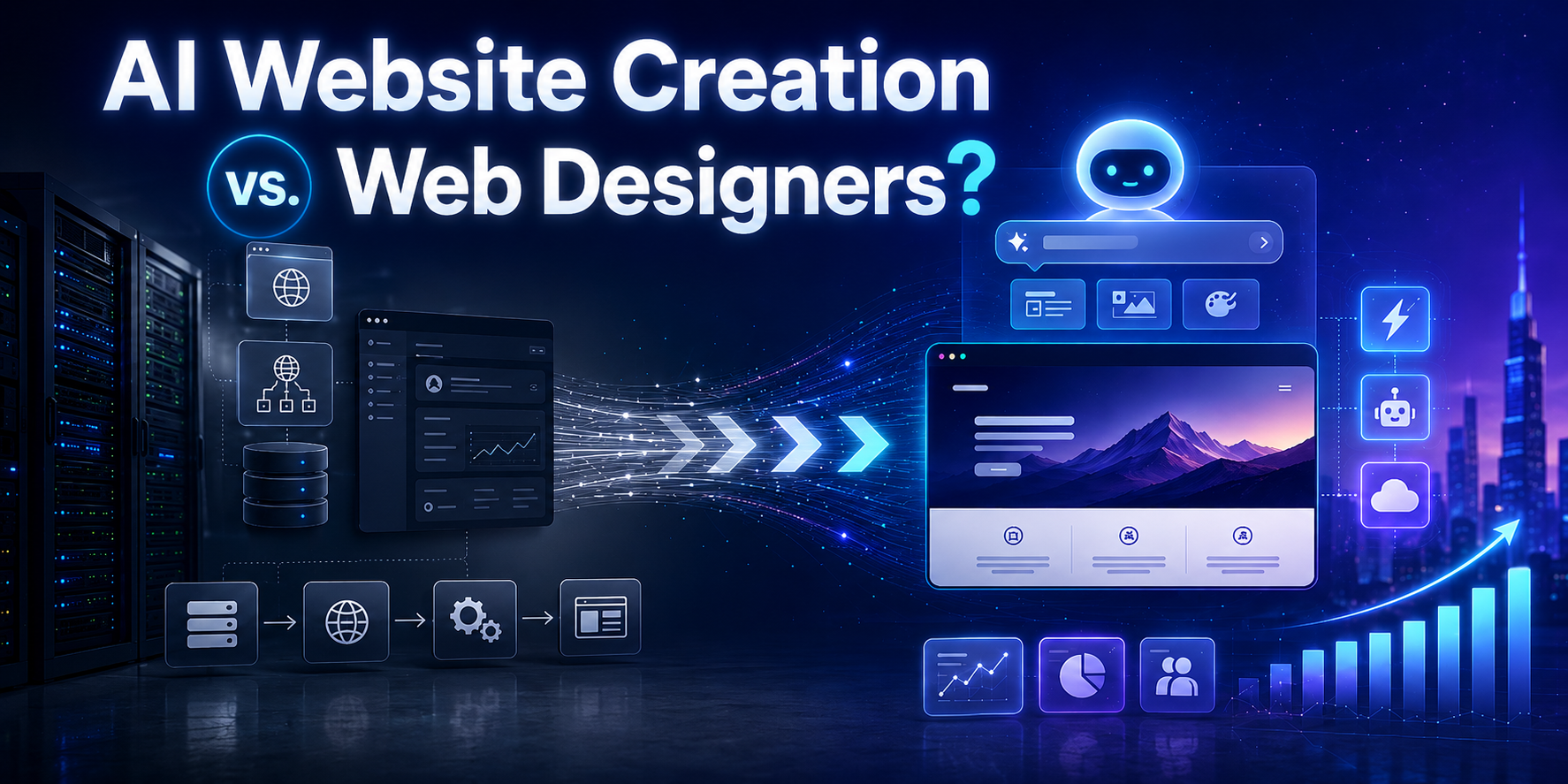
For decades, the web hosting industry was built around a predictable sequence. A customer bought a domain name, selected a hosting plan, installed WordPress or another site platform, hired a designer or picked a template, and then slowly assembled a digital presence. Hosting companies sold storage, bandwidth, email, SSL certificates, DNS, backups, malware protection, and support. Web design firms sold planning, layout, branding, copywriting, development, and maintenance.
That model is not disappearing overnight, but it is being reversed.
The new customer journey increasingly starts with a prompt, not a hosting plan. A small business owner does not necessarily wake up thinking, “I need shared hosting with 20 GB of storage.” They think, “I need a website for my dental clinic,” or “I need to launch my landscaping business,” or “I need a site that takes bookings, ranks locally, and helps me get leads.” AI-first builders are stepping into that moment and saying: describe your business, and we will generate the site, the text, the images, the layout, the booking form, the marketing suggestions, and sometimes even the domain ideas.
That shift should concern traditional hosting companies, but it should not paralyze them. The opportunity is still large. The danger is assuming that the old product categories are what customers will continue to buy.
The Old Hosting Model Was Infrastructure-Led
Traditional hosting companies have usually approached the market from the infrastructure outward. The offer starts with a server account. The customer is then expected to understand the surrounding pieces: domain registration, nameservers, email routing, SSL, CMS installation, plugins, security, updates, and backups.
This made sense when website ownership was mostly technical. A domain name was a starting point. A hosting account was the foundation. A site builder, WordPress installer, or control panel was a convenience layered on top.
But for many small businesses, that model was always too complicated. They did not want hosting. They wanted customers. They did not want DNS. They wanted email that worked. They did not want a WordPress install. They wanted a professional web presence that could bring in leads, appointments, sales, and credibility.
AI makes this difference impossible to ignore.
When a platform can ask a few questions and generate a working first version of a site, the infrastructure becomes invisible. The customer’s first emotional win is not “my account has been provisioned.” It is “my business is online.” That is a very different buying experience.
AI Website Builders Are Not Just Better Templates
It is tempting for hosting companies to dismiss AI website builders as the next version of drag-and-drop tools. That would be a mistake. The strategic threat is not merely that AI can generate a homepage. The threat is that AI can collapse several buying decisions into one guided experience.
A modern AI-first website platform may help choose a business name, suggest a domain, create a logo, write service descriptions, generate images, build pages, set up booking or ecommerce features, and recommend next marketing steps. In that model, hosting becomes one invisible ingredient inside a broader “launch my business” workflow.
This matters because the company that owns the workflow owns the customer relationship. If the AI builder becomes the trusted advisor, the hosting provider becomes a utility provider in the background. That is a weaker position, especially when infrastructure is already under price pressure.
The same issue applies to web design firms. If a client can get a decent first draft of a website in minutes, then charging thousands of dollars for a basic brochure site will become harder. But this does not mean design firms are finished. It means their value must move up the chain.
The Future Is Less About Building and More About Business Outcomes
The most important line in the Hosts Del Mar summary is that commercial and business skills may matter more than the build in the next wave of hosting. That is exactly right.
AI reduces the cost of producing a basic website. It does not automatically produce a successful business. It does not automatically understand positioning, pricing, local competition, trust signals, conversion strategy, customer lifetime value, compliance, accessibility, brand differentiation, or operational follow-through.
This is where hosting companies and web design firms can find a better path forward.
The winning offer will not be “we host websites.” It will be closer to: “we help small businesses launch, secure, manage, improve, and grow their online presence.” Hosting remains part of the stack, but it is not the headline.
That shift creates room for new service bundles. A hosting company can offer AI-assisted website launch, managed WordPress, email, DNS, security, backups, compliance monitoring, uptime monitoring, local SEO support, review generation, analytics, landing pages, and conversion improvement. A web design firm can offer strategy, content direction, brand refinement, lead generation, automation, CRM integration, and ongoing performance reviews.
The product becomes business continuity and growth, not disk space.
AI Also Creates New Operational Advantages for Hosts
AI is not only a market threat. It can also become a major operating advantage for hosting providers.
Support is one obvious area. Hosting support teams handle repetitive issues: DNS propagation, email authentication, SSL errors, WordPress plugin conflicts, PHP version problems, malware warnings, slow sites, failed updates, and billing questions. A well-designed AI support layer can triage these issues, explain them in plain language, suggest likely causes, collect diagnostic data, and escalate cases to the right department.
The key is that AI should not be a generic chatbot pasted onto a support page. For hosting, the AI must understand the actual hosting environment. It should know the customer’s account status, server health, DNS records, email logs, SSL status, resource usage, backup history, malware scans, and open tickets. It should be able to say, “Your site is down because the domain is pointed to the wrong nameservers,” or “Your mail is failing because SPF and DKIM are not aligned,” not merely provide generic advice.
This is where smaller hosting companies can compete. A large platform may have more resources, but a focused provider can build a deeply integrated support and management experience around its own control panel, server stack, and customer base.
AI can also help internally. It can summarize tickets, draft replies, detect recurring problems, identify risky accounts, flag churn signals, generate knowledge base articles, analyze server logs, recommend package upgrades, and help non-senior support staff perform at a higher level. The result is not necessarily fewer people. It may be a better ratio of skilled people to customer outcomes.
Regulation and Trust May Become Differentiators
NIS2 and related cybersecurity expectations point to another major shift: trust, governance, and resilience are becoming more important. This affects DNS, domain management, hosting, cloud services, managed service providers, and security providers.
For customers, this creates confusion. They may not know what NIS2 means, but they will increasingly hear about cyber risk, supply-chain risk, incident reporting, domain abuse, phishing, data protection, and business continuity. Hosting companies that can translate these requirements into practical services have an opportunity.
A forward-looking host should package security in a way customers understand. That may include managed DNS security, domain lock support, DNSSEC guidance, email authentication, malware scanning, web application firewalls, patch management, backup verification, incident response retainers, and clear reporting.
The lesson is simple: as AI makes basic website creation cheaper, trust becomes more valuable. A customer may use AI to generate a website, but they still need someone to keep it online, secure it, back it up, protect its reputation, and help recover when something breaks.
Domains Are Also Changing
The upcoming new gTLD round creates another layer of movement in the domain market. New extensions may create opportunities for registrars, resellers, brands, communities, and niche industries. At the same time, AI discovery may change how people choose names.
Traditionally, domain search was a manual process. A customer typed in a desired name, found it unavailable, and tried alternatives. AI can turn this into a brand-generation process: suggest business names, check domain availability, evaluate memorability, consider SEO, assess trademark risk, recommend social handles, and produce a launch package.
That means domain providers should not treat domains as isolated commodities. Domains should be integrated into business identity. The registrar or hosting company that helps a customer choose a name, secure it, connect it, protect it, and build on it will be more valuable than one that merely sells the cheapest registration.
This is also where wholesale registrars and vendor stacks may become more important for hosting service providers and managed service providers. Smaller firms do not want to assemble disconnected systems forever. They need domain management, billing, provisioning, security, support, and customer-facing tools that work together.
The New Opportunity for Web Design Firms
Web design firms should not try to compete with AI on speed or low-end production cost. That is a losing battle. Instead, they should use AI to reduce production time and focus their human value on judgment.
The low end of the market will become increasingly automated. Simple brochure sites, basic landing pages, starter copy, stock-style imagery, and standard layouts will be generated quickly. But businesses still need positioning, differentiation, trust, and measurable results.
A design firm can reposition itself around questions AI alone cannot fully answer. Who is the ideal customer? What makes this company different? Why should a visitor trust them? What offer should be above the fold? What proof should be shown? What objections must be answered? What action should the visitor take? How should the site connect to the CRM, email marketing, booking system, quote process, or sales pipeline?
In other words, agencies should move from “website builders” to “digital growth partners.” AI becomes the junior production assistant. The agency becomes the strategist, editor, integrator, and accountability partner.
A Practical Way Forward for Hosting Companies
Hosting companies should adapt in five practical ways.
First, make AI-assisted onboarding central to the customer experience. Do not drop new customers into a blank control panel. Ask what kind of business they run, what they need the site to do, whether they need email, booking, ecommerce, SEO, or lead forms, and then generate a guided setup path.
Second, package managed outcomes instead of raw infrastructure. Plans should be named around customer goals: Launch, Grow, Secure, Scale, or Agency. The customer should understand what problem each plan solves.
Third, integrate AI support with real account data. A hosting AI assistant should be able to diagnose actual problems, not merely explain theoretical ones. This requires careful permissions, audit trails, and escalation rules, but it is where the real value lies.
Fourth, build an agency/MSP layer. Many web designers, freelancers, and IT consultants need a platform to manage multiple clients, sites, domains, backups, invoices, and support requests. A hosting company that helps agencies operate more efficiently can grow through channel partners instead of only direct retail sales.
Fifth, become a trusted security and continuity provider. Backups, malware cleanup, uptime monitoring, email authentication, DNS integrity, vulnerability management, and compliance-friendly reporting should be treated as core services, not optional add-ons buried in the checkout page.
The Bottom Line
AI is not the end of web hosting. It is the end of pretending that hosting is the customer’s real goal.
The customer wants a working business presence. They want leads, credibility, security, speed, email, automation, and confidence. AI-first platforms understand this and are moving closer to the customer’s intent. Traditional hosts and web design firms can still win, but only if they stop leading with infrastructure and start leading with outcomes.
The future hosting company will look less like a server rental business and more like a digital operations partner. The future web design firm will look less like a page-production shop and more like a business growth consultancy. Both will use AI heavily, but the winners will not be the companies that simply add a chatbot or an AI site generator. The winners will be the companies that redesign the entire customer journey around what small businesses actually need.
The old model was: buy a domain, pick a plan, build a site.
The new model is: describe the business, launch the presence, manage the operation, improve the results.
That is the opportunity. Hosting companies that understand it early can move from being hidden infrastructure providers to becoming the trusted digital command center for the businesses they serve.